Creative Assembly Lines
Nathan Baschez on why the future of work is not personal agents but factories:
If I had to put my money on the most underrated nascent paradigm shift, it would be factories. Factories are a logical next step after skills and personal agents.[...]
Factory (noun) — a shared AI system designed to handle specific types of tasks within an organization.
Usage: "I am rolling out an update to the slide deck factory so it adheres better to our new positioning, along with a few design fixes for issues we observed last week. Let me know what y'all think!"
[...]
There are three key attributes that define a factory and differentiate it from a personal agent.
Factories are:
- Shared — multiple people on the team can use them.
- Specific — they are optimized to handle certain types of recurring tasks, unlike a general-purpose agent.
- Scrutinized — some people on the team can see the work flowing through the factory to observe and fix failures.
[...]
Some factories are purely autonomous; others involve deep collaboration with humans at strategic points...If you ask most people what an "AI factory" is on X, they'd probably emphasize the lack of humans in the loop, but for me this is the least interesting part about the systems commonly called "software factories." The more important part is that it is a purpose-built, shared system that can be optimized by some people for the benefit of everyone else.
This chimes with my recent thinking and tinkering. It also reminds me of what made Denki so efficient and effective, creative assembly lines:
The challenge facing all creative media businesses today is to establish a system that balances their creativity alongside productivity. Since Denki was set up, we've been carefully defining our own system called (oddly enough), "The Denki Difference".[...]
What we all need - not just in games, but across creative media - is a way to deliver the highest quality product; consistently, and within a commercially realistic timescale (and therefore budget).
[...]
If you look at any history of Motown, one word which crops up time and time again is 'factory' - but not in any negative sense. The whole business was run as a hits factory, pumping out record after record. Yet, despite this relentless productivity they delivered over 110 top tens in a ten year period - that's almost one a month: for an entire decade!
Berry Gordy, Motown's founder, applied the same principle of quality to every aspect of the production process. He used dedicated songwriters. He brought in the best local musicians for recordings rather than the artists themselves. He created 'artist development' to coach his young stars on how to act, behave and present themselves.
Better yet, he held regular weekly meetings to review all of the tracks being worked on and to assess them against the current top five. Any song which he felt wasn't up to scratch, or wouldn't be received well in the charts, was sent back for more work.
[...]
Pixar's website outlines their process for pitching, designing, producing and polishing a movie. It echoes Motown's process closely. Quality control throughout, and the courage to send it back at any point if it's not good enough.
Pixar's approach highlights another key aspect of a successful 'creative assembly line': it's not about the original idea - it's all about the people and the process. Ed Catmull, who's now the president of Disney-Pixar, encapsulates it very neatly: "If you give a good idea to a mediocre team they will screw it up; if you give a mediocre idea to a great team they will either fix it or throw it away and come up with something that works."
For both Motown and Pixar, the important aspects were getting the right teams in place - then creating a process which ensured each and every product received the attention of experts. If it didn't meet expectations, it was sent back - as often as necessary.
This turns one of the basic assumptions of the games business on its head: that the idea is the key to success. If these examples of creative factories prove anything to me it's that the team determines the eventual quality of the product, not the idea.
Colin's creative assembly lines essay is over 15 years old but it still holds up. What made Denki work was exactly what Baschez describes. Shared standards and processes everyone focused and aligned around. Specific operating procedures for recurring tasks across design, development, delivery, operations and awareness. Scrutinised through adaptive planning, iterative and incremental delivery, continuous improvement and knowledge sharing.
What Colin overlooked, or more accurately undervalued, was ideas.
I agree the original idea isn't what drives and defines success. But within our creative assembly lines, ideas happened all the time. Ideas that optimised the end-to-end flow of value. Ideas that shortened feedback loops. Ideas that plussed the concept and improved the end product.
The idea isn't what goes in at the top. It's what flows through the loops.
If you were to rebuild Denki today, it would be a tiny team inside a network of agentic factories.
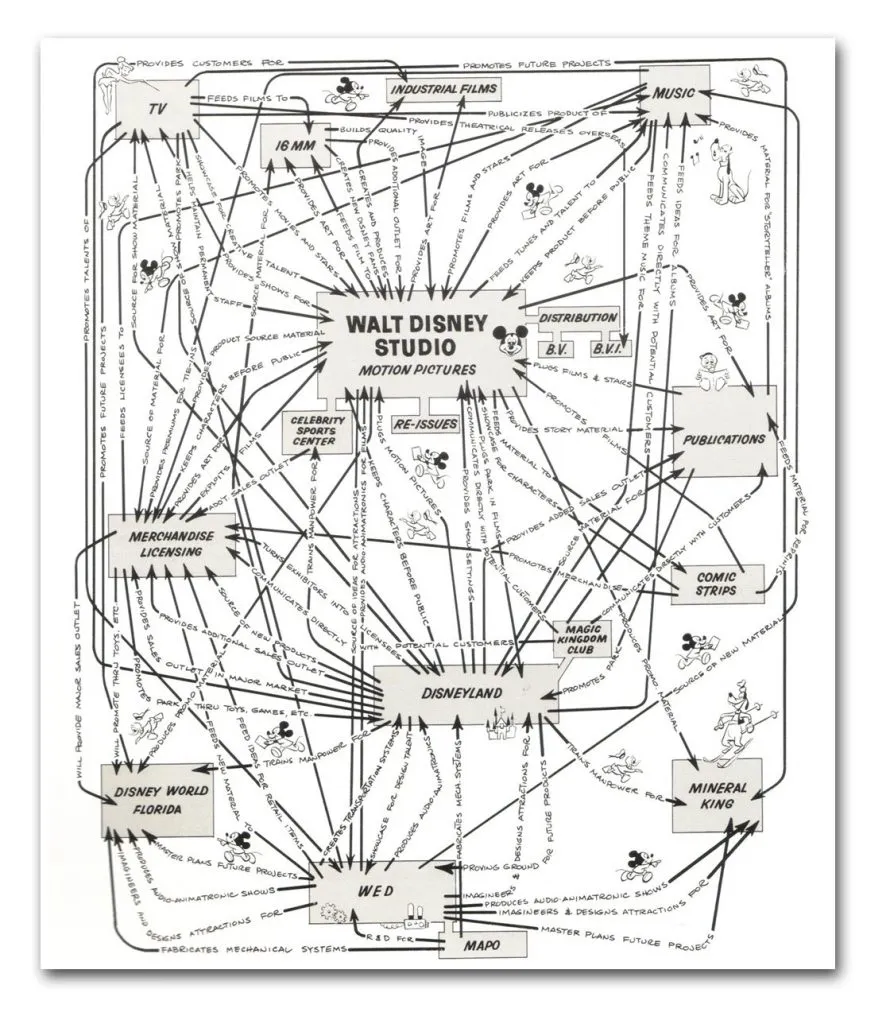
We already have a 59-year-old blueprint