Edge Cases
Dylan Collins reckons the gaming singularity has started:
My (somewhat non-Kurzweilian) definition of the gaming singularity is zero distance between the creative idea for a game and the completed development of that game.Game development is now on a path where cycles are getting shorter, improvements compound and ultimately the concept of game development will evaporate and only creativity will remain. At some point on this timeline you can imagine a thing and it will instantly exist. For now, we're at prompts and tokens. The transition to vibe generated content (VGC) has begun.
I think he's directionally correct. But he's underestimating the hate.
Joakim Achren has the numbers:
In GDC's annual surveys, the share of game industry professionals who said generative AI was having a negative impact rose from 18% in 2024 to 30% in 2025 and 52% in 2026. Only 7% saw a positive impact in the latest survey.In [Quantic Foundry's] survey of 1,799 players, 85% had a negative attitude toward generative AI in games. Almost all respondents were core or hardcore gamers, so this tells us about that audience rather than all players.
For the legacy core, AI isn't a tool question. It's a loyalty test. Developers and players are bound by the same deal: we suffered to make it, you pay because we suffered. For a lot of them, there is no acceptable amount.
That won't stop the singularity. But it might sort it.
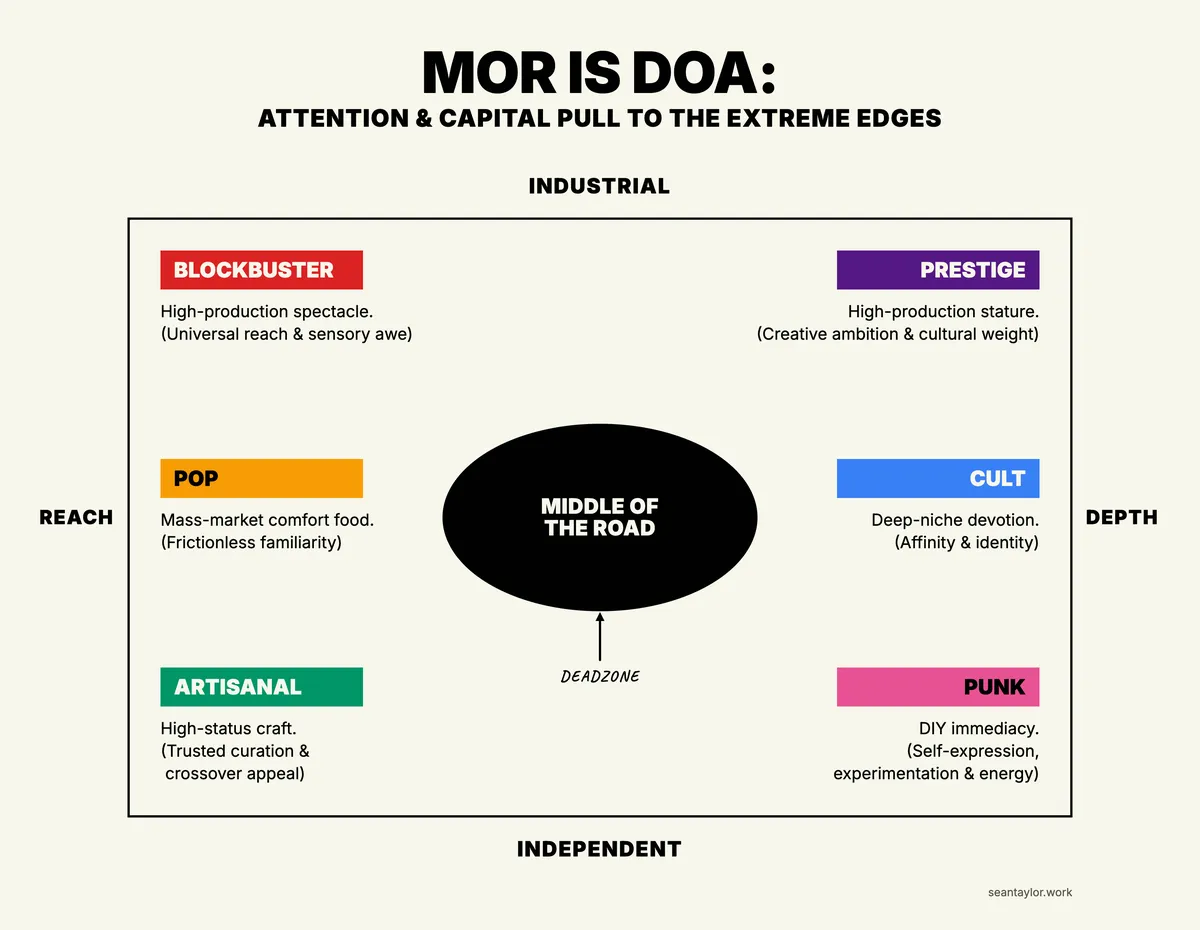
Vibe generated content pours into Pop and Punk. Cheap, instant, made for an audience of one.
Human-made retreats to Prestige, Cult and Artisanal, where provenance becomes identity.
Blockbusters will use it quietly. They're big enough to absorb the hate and impossible to ignore.
The middle gets squeezed from both sides. Too expensive to compete with free. Not precious enough to be worth defending.
Zero distance is the pitch.
For the core, the distance is the product. Proof that somebody sweated over this.